Showing posts with label copyright. Show all posts

24 September 2011

Apple ipad and 2001


As any 5-year-old is all too happy to point out, most things look like other things. The ongoing slapfight over patent infringements that’s defining the mobile technology market these days is largely based on everyone’s little black-or-white rectangle looking identical to everyone else’s.

No company appears more intent on blocking everyone else from selling tiny black rectangles than Apple (NASDAQ:AAPL). The company is waging an international litigation war against Samsung (PINK:SSNLF) looking to block its line of Galaxy portables from releasing in a growing number of markets. Samsung, of course, claims Apple is being ridiculous. 

The Korean technology company’s lawyers filed a declaration with a federal district court in California on Aug. 15 that said Apple’s iPad replicates the design of mocked-up tablet computers used in Stanley Kubrick’s film adaptation of 2001: A Space Odyssey. The filing even included a YouTube link to demonstrate. It points to how Dave and another astronaut are using machines with “an overall rectangular shape with a dominant display screen, narrow borders, a predominantly flat front surface, a flat black surface, (and) a thin form factor.” This is, the filing says, identical to the design featured in Apple’s D’889 Patent.

full story
http://www.investorplace.com/2011/08/also-sprach-samsung-apple-cant-copyright-ipad-because-of-2001-a-space-odyssey/


19 April 2011

ISP download responsibility


"The issue is essentially about whether content owners or ISPs should assume the cost of policing downloading. ...

The federal government should also consider the extent to which an account holder should be liable where the downloader is a person other than the account holder, as can occur when downloading takes place via an open access wireless network or through mobile broadband. "

full article at the SMH

04 April 2011

Street Art & Copyright

Q. When does "fair use" end and copyright infringement begin?
A. As soon as there are large sums of money involved.
(ed)

Article
Street artist Mr Brainwash sued over “copied” image


" it is likely more copyright infringement cases will be brought against street artists. “There should be more cases like [Friedman’s],” he says. “It definitely will go that way because of all the money [street artists] are making.”"

While street art’s predisposition towards copying, sampling and riffing on pre-existing imagery may have an art historical precedent in pop art, its underground status has, until now, largely protected it from litigation. “Most street artists follow in the footsteps of Warhol by taking popular images as the basis of their work,”

Street artist Thierry Guetta, better known as Mr Brain­wash, is being sued by a photographer for copyright in­fringement over a well-known image of rap group Run DMC .... Law­yers acting for photographer Glen Friedman say Guetta reproduced his 1985 photograph without authorisation and used it in unique works of art, prints and promotional material, including postcards for his 2008 debut exhibition in Los Angeles, “Life Is Beau­tiful”. Friedman’s lawyer, Douglas Linde, says they are entitled to a share of “indirect profits” from the exhibition. Linde is seeking unspecified damages for “damage to [Fried­man’s] business in the form of diversion of trade, loss of income and profits, and a dilution of the value of its rights”.

Guetta, who denies the copyright infringement allegations, is claiming “fair use”, which under US law allows for the limited reproduction of copyrighted works for the purpose of parody or other creative ends.

Warhol was sued by several photographers, including Patricia Caulfield after he used her image in his 1964 “Flowers” series (all disputes were settled out of court), while Robert Rauschenberg agreed to an out-of-court settlement with photographer Morton Beebe after a case was brought against him over his 1974 work, Pull.

Richard Prince and his dealer Larry Gagosian, are currently the subject of a copyright infringement case brought against him by photographer Patrick Car­iou, who claims Prince lifted his photographs of Rastafarian culture for a series of paintings entitled “Canal Zone”. The series was exhibited at Gagosian gallery in New York in November 2008, where, according to Gagosian’s court filing, eight of the 22 paintings were sold for between $1.5m and $3m. Prince, who claims his use of Cariou’s photographs are protected by “fair use”, said that the photographs are not “‘strikingly original’ or ‘distinctive’ in nature”, and that his “transformative” uses of the photographs were “done in good faith and reflect established artistic practices”.

==============
More on copyright on Blakkbyrd
http://blakkbyrd.blogspot.com/search/label/copyright

More Art Scandal
http://blakkbyrd.blogspot.com/search/label/art%20scandal

18 March 2011

Copyright Infringement


Article: Is a Cease and Desist About Irony, Hypocrisy or Legal Strategy?


"Indeed, a quick Google search will show that doing IP and trademark research, and sending out cease-and-desist letters, are a regular part of a legal intern’s job description. These letters are sent out with no greater strategy in place than to cast a wide net in hopes of catching all potential offenders. ...

Sometimes an artist may very well file a suit only to stake a claim — to pee on the post that marks the artist’s territory. As the ability to poach artwork with ease grows, so, along with it, does the necessity of producing, what is now being termed, a “chilling effect” to strike fear into the hearts of would-be offenders. ...

The thing to keep in mind in many of these cases is that what looks like hypocrisy in the broad view, may also be good business when it comes to trademark and copyright maintenance. An artist (or corporation, or artist run corporation) must keep the brand in the forefront of people’s minds, clear and unsullied by distractions."


More on Hirst, Koons and Fairey

full article

http://hyperallergic.com/20398/cease-and-desist-strategy/


21 May 2010

Carnival of Souls


http://www.youtube.com/watch?v=nMK4zlfCw1E


Here's the preview of JAZAN WILD'S CARNIVAL OF SOULS Motion Comic Book! This Groundbreaking Series led the way in this new frontier.
See all 4 chapters of the story at:

http://www.youtube.com/JAZANWILD


The story begins with a boy and his mother on a simple trip to a carnival. It quickly turns and takes you spinning on a wild ride into the heart of the jungle! Fasten your seat belt and pull the safety bar down. It's a roller coaster ride from Hell! No matter how much you scream you can't get off! Once you hand in your ticket, you hand over the deed to your very soul. Welcome Ladies and Gentlemen ... to Chapter 1 of Jazan Wild's Carnival Of Souls!

================
The creator of a graphic novel is suing NBC Universal for $50m (£40m) claiming the final series of Heroes ripped off his storyline.

Jazan Wild, real name Jason Barnes, says NBC used a carnival "virtually identical" to the ones depicted in his digital book series Carnival of Souls.

By doing so the network "knowingly, wilfully, recklessly and maliciously infringed" on his copyright, he claims.

more
http://news.bbc.co.uk/2/hi/entertainment_and_arts/10130762.stm

==================


Heroes & Carnival compared
http://robot6.comicbookresources.com/2010/05/see-carnival-of-souls-comparisons-from-60-million-heroes-lawsuit/

19 February 2010

Kimberley Baker - Canada


Artist statement

"In this body of artwork I am investigating the Vancouver 2010 Olympics and growth machine politics. My goal is to address the key issues and debates of homelessness, freedom of expression, the environment and the representation of place as a consumable commodity. The intention of this work is create a visual narrative that encourages and engages public dialouge.

The images I have designed incorporate appropriation art as a way of to protest Canadian Bill C-47, the Olympic and Paralympic Marks Act, legislation that provides the Vancouver Olympic organizers with extreme power and domination over the symbols and language linked with the Olympics.

In opposition to the latest civil liberties violation, the 2010 Olympic and Paralympic Winter Games: Vancouver Bylaw Ammendments (2009). I am distributing my posters throughout the streets of Vancouver's downtown core. As a way of asserting my right to freedom of expression under the Canadian Charter of Rights and Freedoms."

http://kimberlybaker.ca/index.php?mpage=2008&gid=7

========
VANOC 2010 bullies outspoken artist Vancouver's 2010 Olympic organizing committee has already attempted to put restrictions on Canadian artist Kimberly Baker, according to an article Baker wrote for Common Ground in the magazine's most recent issue.

Baker reports that her art, a series of five images of a man in a sleeping bag beside a grocery cart, with each image in a colour of the Olympic rings, resulted in a warning from Colin Jarvis, manager of "Commercial Rights Management" for VANOC. Baker says that Jarvis told her if she displayed her poster on bill boards across the Downtown Eastside, there would be a problem because that action would be considered creating a “campaign,” as opposed to displaying a work of art.

..... visit her website (KimberlyBaker.ca) for more details on the ongoing dispute.

From Kimberly's website:
"Throughout history artists have played an important role, turning their art into a political weapon that questions and confronts the power structures that are in place. My artwork the Transit Shelter Project focuses on the current debates around the Vancouver 2010 Olympics."

From the Common Ground article:
". . .I don’t see VANOC as the villain in this scenario; rather, it is the larger problem of our legal system prioritizing corporatism over creativity. I have learned from this experience that copyright legislation being put in place today has not kept up with the changes that have occurred in the modern art world."

http://davideby.blogspot.com/2007/08/vanoc-2010-bullies-outspoken-artist.html

============


Baker said she was particularly incensed by amendments that would allow the city to remove graffiti and “illegal signs” from private property without notice, and fine repeat offenders up to $10,000 a day. “I’m definitely going to challenge that, because that just made me mad,” she said. “I think it’s a direct infringement of our freedom of speech.”

more
http://www.straight.com/article-198482/artist-takes-charter-amendments

29 October 2009

Shepard Fairey - Obama discussion

Interesting discussion from the Intellectual Property Colloquium on the Shepard Fairey v Associated Press Obama Poster case.

Of special interest to any street artist re-mixing media images.

full details/listen online/or download podcast here

http://www.ipcolloquium.com/Programs/8.html

16 October 2009

Web 2.0 Copyright


User-generated content & Web 2.0
websites:  March 2009
From The Australian Copyright Council


In this information sheet we give an overview of copyright issues that apply when website proprietors invite
people visiting their site to create or post user-generated content (UGC). Popular examples include:
• social networking sites (such as MySpace, Facebook and Twitter);
• image/photo/film-sharing sites (for example, YouTube, Shutterfly and Flickr);
• blog sites that invite comments and responses;
• information sources (such as Wikipedia);
• game and virtual reality sites (such as Second Life); and
• entrepreneurial ventures with UGC elements (such as book, CD and travel sites which invite customers to
post reviews).
We particularly focus on the issues a website proprietor needs to be aware of when setting up such a site.


Information sheet:

13 September 2009

Cartrain & Hirst - part 2, pencils


The story...
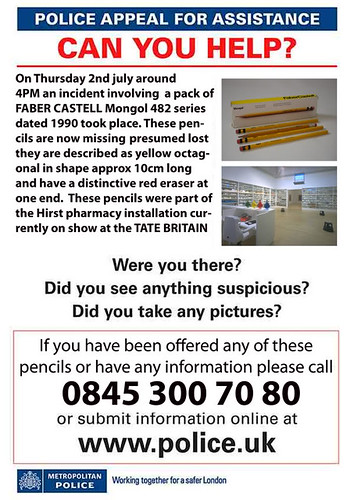
16 year old graffiti artist Cartrain walked into the Tate Britain (London) and removed a packet of pencils from one of Damien Hirst exhibits. Damien Hirst and Cartrain have a long-standing rocky history. Earlier this year Hirst targeted the young graffiti artist Cartrain using Design and Artists Copyright Society (DACS) for breach of copyright infringement on his latest series of artworks being sold via 100artworks.com.

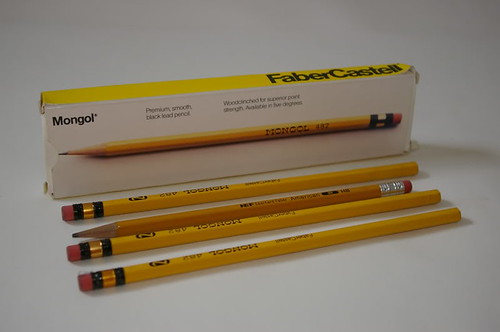
The box of very rare "FABER CASTELL dated 1990 Mongol 482 series" pencils were removed from Damien Hirst's "PHARMACY installation" by Cartrain on Thursday the 2nd of July around 4pm. Not long after the pencils were removed from the installation a fake police 'appeal for assistance' posters appeared all around London.


Cartrain's Demands...
For the safe return of Damien Hirst's pencils I would like my artworks back that DACS and Hirst took off me in November. It’s not a large demand. He can have his pencils back when I get my artworks back. DACS are now not taking any notice of my emails and I have asked nicely more than five times to try and resolve this matter. Hirst has until the end of this month to resolve this or on 31st of July the pencils will be sharpened. He has been warned.

Image of police poster...
http://www.flickr.com/photos/100artworks/3696754195/in/set-72157606942599051/

Cartrain was arrested on Friday the 17th July 2009. The same day the story was printed in the Independent newspaper. He was arrested and put on on bail until September the 11th 2009.

Charges...
-10,000,000 pounds worth of damages (yes that's 10 million).
-500,000 pounds worth of theft.

Bail conditions...
-Cartrain is not allowed to post anything on the Internet.
-Cartrain is not allowed in any public building that displays art.
-Cartrain is not allowed in any public or private building displaying Damien Hirst's artworks.

If Cartrain is convicted we think this will be the highest value modern art theft on UK soil. The pencils have to be placed back in to the installation by Hirst in person.

Image of the police bail form...
http://i8.photobucket.com/albums/a34/Cartrain/BAIL.jpg

Sources of information...
http://www.100artworks.com/catalog/cartrain-m-65.html
http://cartrainlondongraffiti.blogspot.com/

Pencil Images...
http://www.flickr.com/photos/100artworks/3707603610/ (Print pulled form sale)
http://www.flickr.com/photos/100artworks/3707602796/ (the pencils)
http://www.flickr.com/photos/100artworks/3696754195/ (fake Cartrain police poster)

Cartrain Images about Hirst...
http://i8.photobucket.com/albums/a34/Cartrain/Fortheloveofspamcopy.jpg
http://i8.photobucket.com/albums/a34/Cartrain/Hirstgraveyardcopy.jpg
http://i8.photobucket.com/albums/a34/Cartrain/Hirstpharmacycopy.jpg
========
from
100artworks online urban art gallery
http://www.100artworks.com/catalog/cartrain-m-65.html

-===========
Its interesting how Hirst gets his pencil valuation of 500,000 pounds. According to Australian accounting, you value assets at the LOWER of cost price or market price. So the question is, how much did Hirst pay for the pencils? He can make up any large figure he likes for market price, but the accounting valuation will still be the cost price if it was lower. Perhaps the UK rules are different, but I doubt it.


29 April 2009

Street Photo Copyright - NZ


On matters of appropriation/IP infringment/protecting your work.
By oscar
30 July 08

On a rainy evening a few weeks ago I met up with some friends (all artists + a midwife) to go check out an exhibition. Something we would have done countless times before, only this exhibition was different.
Some time last year one of my friends got word photo’s of his work were being printed on canvas and sold through a gallery (his work being a stenciled image painted outdoors). He looked into it and found out the work had been sold, possibly more than once and the particular photograph was a very closely cropped image showing no contextual information other than it being on a concrete textured wall.


full article and comments
http://streetarse.co.nz/archives/216


Urban Photograhy by Lucy G
http://www.lucygdesign.com/urban/

see prior Blakkbyrd post Sept 08
http://blakkbyrd.blogspot.com/2008/09/graffiti-law-in-australia.html

22 April 2009

Remix - talk at the NYPL


Remix: Making Art and Commerce Thrive in the Hybrid Economy LIVE from the NYPL & WIRED present LAWRENCE LESSIG, SHEPARD FAIREY and STEVEN JOHNSON February 26, 2009

What is the future for art and ideas in an age when practically anything can be copied, pasted, downloaded, sampled, and re-imagined? LIVE from the NYPL and WIRED Magazine kick off the Spring 2009 season with a spirited discussion of the emerging remix culture.

Our guides through this new world—who will take us from Jefferson's Bible to André the Giant to Wikipedia—will be

Lawrence Lessig, author of Remix, founder of Creative Commons, and one of the leading legal scholars on intellectual property issues in the Internet age;

acclaimed street artist Shepard Fairey, whose iconic Obama "HOPE" poster was recently acquired by the National Portrait Gallery;

and cultural historian Steven Johnson, whose new book, The Invention of Air, argues that remix culture has deep roots in the Enlightenment and among the American founding fathers.

http://www.artbabble.org/video/remix-lawrence-lessig-and-shepard-fairey-live-nypl-22609

(Its nearly two hours long and very interesting)


05 February 2009

Electronic Frontier Foundation

From the Internet to the iPod, technologies are transforming our society and empowering us as speakers, citizens, creators, and consumers. When our freedoms in the networked world come under attack, the Electronic Frontier Foundation (EFF) is the first line of defense. EFF broke new ground when it was founded in 1990 — well before the Internet was on most people's radar — and continues to confront cutting-edge issues defending free speech, privacy, innovation, and consumer rights today. From the beginning, EFF has championed the public interest in every critical battle affecting digital rights.

http://www.eff.org/about

blog
http://www.eff.org/deeplinks/archive

07 January 2009

Lekay, Hirst and Cartrain - copyright dispute


But Cartain, the moniker for the teenage artist, has earned the ire of Damien Hirst for incorporating photographic images of his platinum cast of a human skull, For the Love of God, into his graffiti prints. The two artists have become locked in an unlikely art clash that has led Hirst to demand recompense from the teenager for selling £200 worth of images of his skull without permission, says Private Eye magazine.

In spite of his tender years, Cartrain's graffiti can be seen on the backstreets of east London's Brick Lane and Old Street, and his stencils and collages containing recognisable figures such as George Bush and the Queen are sold alongside other emerging artists. He made a series of collages using photographs of Hirst's skull, some of which imposed the bejewelled sculpture over the faces of figures taken from other photographs. One showed the skull in a shopping basket alongside some carrots. The images were displayed in the online gallery, 100artworks.com, where Cartrain's collages sell for £65, on average.

He was surprised to learn Hirst had not only seen the work but also contacted the Design and Artists Copyright Society (Dacs), who apparently informed the young artist he had infringed Hirst's copyright. The older man has reportedly demanded that Cartrain not only remove the works from sale but "deliver up" originals, along with any profit made on those sold, or face legal action.

Cartrain said: "I made a few collages and my gallery put them up for sale online. After two weeks, the gallery received an email from Dacs stating I had infringed Damien Hirst's copyright on the title of the work (For the Love of God) and that I was to forfeit £200 in fees and the artworks. I handed over the artworks to Dacs on the advice of my gallery. I met Christian Zimmermann [from Dacs] who told me Hirst personally ordered action on the matter."On his internet forum, Cartrain commended those buyers who managed to secure one of his collages featuring the skull. "Well done to everyone that purchased one before Hirst got involved," he wrote.Dacs refused to comment.

But Hirst's complaint was seen as ironic by some in the art world, given the controversy surrounding the provenance of his skull. Three weeks after the artist unveiled the £50m sculpture, another artist, John LeKay, claimed he had been producing similar jewel-encrusted skulls since 1993. LeKay, who said he had been a friend of Hirst's between 1992 and 1994, said: "When I heard he was doing it, I felt like I was being punched in the gut. When I saw the image online, I felt that a part of me was in the piece. I was a bit shocked."The 46-year-old London-born artist used crystal to make his skulls glisten. He was quoted as saying: "When the light hits it, it looks as if it is covered in diamonds."

more

http://www.private-eye.co.uk/

http://100artworks.com/

100artworks.com representing...
A1one - Aniel - Bitches In Control - Boortorrie - Cartrain - Ces53 - Chiba Love - EeLus - FAKE - GVD - Krah - Kryot - Lastplak - Lord Kronington - Luke Insect - Lunartik - Otick - Reno - Sickboy - Static - Sztuka Fabryka - TOAD - Un-Plugged - ViGO -

========


Damien Hirst has been accused of copying yet another artist’s ideas. Three weeks after the artist unveiled his diamond-encrusted skull with a price of £50 million, another artist, John LeKay, has told The Times that he has been producing similar jewel-encrusted skulls since 1993 (see image 2, left). He also believes that it is not the only one of his ideas that Hirst has used in some way. LeKay, a 46-year-old Londoner who lives in New York, created 25 of the skulls in 1993. Inspired by Mayan skulls, he used crystal to make his skull glisten. “When the light hits it, it looks as if it is covered in diamonds,” he said. Over the years, he has explored the idea repeatedly, covering skulls made of soap and wax with artificial diamonds and Swarovski crystals.

full story

17 April 2008

Economies of the Commons - de balie

Economies of the Commons

Strategies for Sustainable Access and Creative Reuse of Images and Sounds Online

International Working Conference
Amsterdam & Hilversum 10, 11 & 12 April 2008

This dossier documents and brings together background materials for the international conference Economies of the Commons. This public working conference and its side programs address the remarkable cultural, educational and societal significance of the new types of audiovisual commons resources that are currently being created on the internet. Sustainable public access and enhanced opportunities for creative reuse of these resources are the particular focus of this conference and this web dossier.

http://www.debalie.nl/dossierpagina.jsp?dossierid=208416


31 January 2008

Shepard Fairey


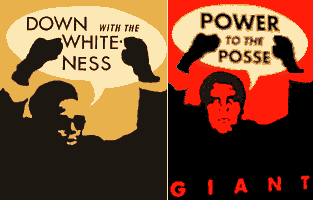
Left: Down with the Whiteness - Rupert Garcia. Silkscreen print. 1969. In the permanent collection of the Fine Arts Museum of San Francisco. Right: Shepard Fairey’s rip-off version of Garcia’s silkscreen. Fairey published his plagiarized version in his book, Supply and Demand. No credit was given to Rupert Garcia.]

http://www.art-for-a-change.com/Obey/index.htm

Obey Plagiarist Shepard Fairey
A critique by artist Mark Vallen
Published on the occasion of Fairey’s Los Angeles solo exhibition, Dec., 2007.


12 November 2007

18 October 2007

BYRD & BANKSY


In 2003 I made an original limited edition print containing a signature character of a girl holding balloons. It is entitled 'ladybird'.
Its an autobiographical piece relating to a childhood event.
The balloons represent hope and are a reference to overcoming adversity.

The image is covered by my artist's copyright.


Here is a well known BANKSY image containing a girl holding balloons.
It is dated 2005. I dont know the date that the stencil was first cut.


When I put Ladybird up
at KATTENBAK in 2007, it was a reference to my earlier character, not a tribute to BANKSY.


The concept of a character flying suspended from a balloon is a long established tradition. See for example the original Winnie the Pooh.

17 September 2007

YouTube Privacy Risks

VW 'Nazi' Subpoena Points Up YouTube Privacy Risks.

A legal spat between YouTube and Volkswagen is throwing light on the increasing copyright surveillance of social networking sites.

Volkswagen has filed a subpoena seeking the identity of a YouTube user who posted a Nazi-themed parody of a recent VW Golf commercial. Volkswagen's move underscores the privacy risks to a blossoming community of users on sites like YouTube and Yahoo Video, and social-networking sites like Facebook and MySpace.

Copyright holders and their agents have long been monitoring activity on file-sharing networks such as BitTorrent and Gnutella. Now they're turning their attention to the social networks.

"The social networking sites have definitely become a new focal point," said Evan Cox, a San Francisco copyright attorney who, with his colleagues, issue thousands of takedown notices a year. "As a consequence, they've gotten more focus from copyright owners."

Volkswagen alleges the video violates its copyrights, according to San Francisco federal court documents. The doctored video has been removed from YouTube and is no longer available. The VW subpoena is the first legal step toward what could grow into a copyright infringement lawsuit. Volkswagen did not reply to several messages seeking comment.

more...
http://www.wired.com/entertainment/hollywood/news/2007/09/vw_parody_ad


10 April 2007

Second Graders Learn Copyright Lesson the Hard Way

teacherartexchange digest: April 08, 2007
teacherartexchange@lists.pub.getty.edu

Subject: Second Graders Learn Copyright Lesson the Hard Way
From: "Judy Decker" <***>
Date: Sun, 8 Apr 2007 13:10:36 -0400
X-Message-Number: 1

Dear Art Educators,

One teacher's second graders learned a lesson in copyright law the hard way. They created watercolor paintings of dogs in the style of Daniel Kessler.
http://www.kesslerart.com/
http://www.kesslerart.com/cats_and_dogs.html

The teacher was so excited about the children's paintings that she emailed the artist giving him her Artsonia link. Daniel Kessler was not flattered by the second graders' imitation of his work. Rather, he had his lawyer contact Artsonia directly to have the work removed from he site.

Here is just one sample of the second grade paintings - all were very similar to Kessler's
http://www.princetonol.com/groups/iad/Files/dog.jpg
Students used different colors but all were similar - with apple on dog's head. This image will only be at this location for a short time - for illustrative purposes.

Second graders copying his style was not Fair Use.

You can read the discussion on this thread on Art Education list.
http://groups.yahoo.com/group/art_education/

I think we can all come up with a way this lesson could have been done that would not have violated copyright so I won't list ideas here. I will post one reply from *** as it was a good one.

From ***:

At the risk of being in the minority and raising the ire of some of this list, may I suggest that Kessler has a point? Because there is little variation between and among the artworks produced by the children, I suspect that Kessler viewed this not so much as children learning about his style; rather that the dogs are copies of his work.

Kessler's dog illustrations are the source of his livelihood. They are copyrighted images (this is plainly stated on his website) in the same way that books are copyrighted. For them to be copied and then sold--regardless that the copying was by children and regardless that they are cute--is taking from the artist's source of income.

========
From ****** Thu Apr 05 13:40:46 2007

I'm so bummed about what just happened. I had my 2nd graders make these awesome abstract dogs in the style of Danie l Kessler, living artist from Washington DC.

I told my students I would email him after I uploaded their artwork to our online gallery on Artsonia and send him a link so that he co uld admire their attempt to imitate his work.

I thought he would be flattered. Instead, he had his lawyer contact Artsonia and delete the whole gallery claiming it was a copyright i nfringement.

What? Artsonia makes money on parents buying items with student artwork on it. But a large number of pieces of art teachers have students make is based on famous art. Should all that be deleted too?

What I think it all amounts to is bad news for my poor 2nd graders who had an art teacher who thought she had a good idea in contacting the artist. Bummmmmmer.

And besides, my students' artwork would have only made people more curious about Daniel Kessler and more likely to buy his work.

I put some of these abstract dogs on my school website if you want to see w hat I'm talking about: [dead link]

===========

editors note

I was asked to remove the url of a dead link .... what difference does it make?

who knows?